
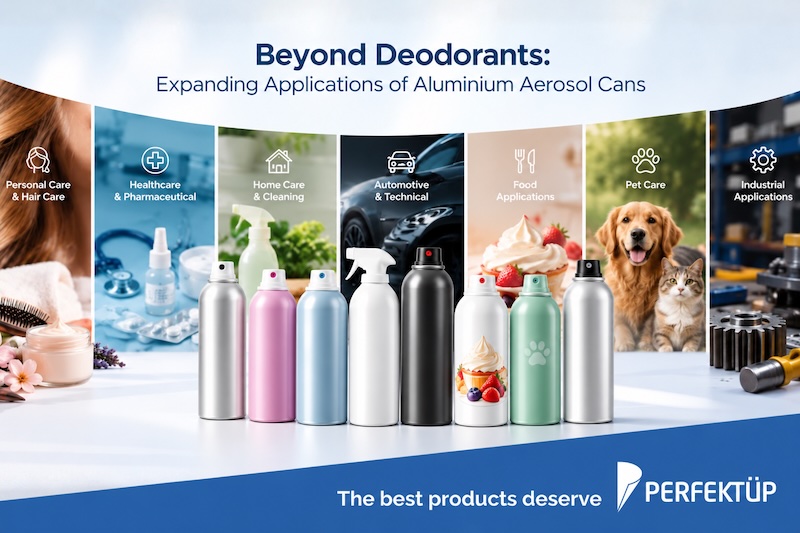
Ask most people to picture an aluminium aerosol can and they will think of a deodorant. Decades of widespread use in personal care have made the format familiar to consumers worldwide and secured aluminium aerosol packaging a firm place in the beauty and cosmetics industry.
Deodorants, however, cover only part of the picture. Dry shampoos, hair styling products, pharmaceutical sprays, household cleaners, automotive treatments and selected food products all rely on aluminium aerosol cans, each with its own formulation, performance requirements and consumer expectations.
That versatility matters more as brands look for packaging that protects the product, is easy to use, stands out on shelf and makes more efficient use of materials. For Perfektüp, which has decades of experience in aluminium aerosol can manufacturing, the growth of these markets confirms a simple point: the same packaging technology can serve many industries, provided its technical specifications are adapted to the product inside.
Aluminium Aerosol Cans: A Packaging Market with Expanding Opportunities
The global aerosol packaging industry continues to grow, supported by demand from personal care, household, healthcare and industrial applications.
According to the latest analysis from Fortune Business Insights, published in September 2026, the global aerosol can market, which includes aluminium and other container materials, is projected to reach USD 12.31 billion in 2026. It is expected to grow at a compound annual growth rate of 5.91%, reaching USD 19.49 billion by 2034.
Within this market, aluminium stands out for its mechanical strength, low weight, corrosion resistance and design flexibility. It can also be manufactured into seamless monoblock containers, which suits products that need reliable pressurised packaging and consistent performance throughout their intended shelf life.
Growth does not mean simply moving existing formats into new product categories, though. Each application calls for its own combination of container dimensions, internal coatings, filling conditions, dispensing components and pressure resistance.
As more industries explore aerosol delivery, packaging manufacturers need to pair production expertise with a detailed understanding of the products their customers want to develop.
Dry Shampoos: One of the Most Dynamic Opportunities in Hair Care
Of the applications widening the role of aerosol packaging, dry shampoos deserve particular attention.
Dry shampoo began as a convenient way to refresh hair between washes and has since become an established hair care category. Consumers now use it not only to absorb excess oil but also to add volume, improve texture, revive a hairstyle and stretch the time between conventional washes.
This growth reflects changing lifestyles and a preference for convenient, multifunctional beauty products. Travel, fitness, busy schedules and interest in waterless hair care have all played a part.
According to the Fortune Business Insights report updated in September 2026, the global dry shampoo market is projected to reach USD 5.19 billion in 2026 and to grow at a CAGR of 12.56% through 2034, when it is expected to reach approximately USD 13.37 billion.
Spray formats remain central to the category. The latest complete annual data, for 2025, indicate that spray-based dry shampoos accounted for approximately 62% of the global market. This figure covers spray products as a whole rather than aluminium aerosol cans alone, but it confirms how much weight convenient spray application carries commercially.
The products themselves are changing too. Traditional oil-absorbing formulas now sit alongside tinted versions for different hair colours, scalp-conscious formulations, fragrance-led ranges and products with added styling benefits.
These developments raise specific packaging questions. Aerosol dry shampoos can contain fine absorbent particles, fragrances and other ingredients, so the complete dispensing system needs careful evaluation. Container compatibility, internal coating selection, pressure conditions and the interaction between formulation and dispensing components all affect product performance.
For packaging manufacturers, the task is to support increasingly sophisticated formulations while keeping quality consistent across product ranges and production volumes.
This is where Perfektüp’s expertise in aluminium aerosol cans is particularly relevant. Its range of container dimensions, internal lacquer options and decoration technologies offers a foundation for packaging configurations suited to different hair care products. Working with brands and filling partners during development brings technical requirements into the discussion early and reduces the risk of incompatibility between packaging and formulation.
As dry shampoos move further into premium and specialised hair care, technical reliability combined with packaging differentiation is likely to become a growing advantage.
Beyond Dry Shampoo: Hair Styling and Personal Care Applications
Dry shampoo is only one example of what aluminium aerosol packaging offers in hair care: hair sprays, volumising products, styling mousses, texturising sprays and certain leave-in treatments are all established applications in which aerosol delivery provides convenience and controlled distribution.
Their requirements differ considerably. A hair spray designed for fine, even application poses different challenges from a styling mousse that must dispense a consistent foam, and formulations with conditioning ingredients, fragrances or specialised styling polymers may need different packaging and dispensing configurations.
Aerosol formats also play an important role beyond hair care, in shaving products, body care and sun protection. Shaving foams and gels depend on packaging that dispenses a consistent texture, while aerosol sunscreens are developed to ease application over larger areas of the body. In each case, performance depends on the complete system: formulation, container, valve and actuator.
Appearance matters across these categories as well. Premium personal care brands often look for distinctive shapes, surface finishes and decoration that communicate positioning before the consumer has used the product.
Perfektüp supports these requirements with aluminium aerosol cans in different diameters, shoulder profiles and customised shapes, combined with high-definition printing in up to nine colours and a range of decorative finishes. Assessing packaging design alongside manufacturing feasibility helps brands differentiate their products without losing sight of the practical demands of industrial filling and production.
Pharmaceutical Sprays and Healthcare: When Packaging Performance Is Critical
Pharmaceutical and healthcare applications show the versatility of aluminium aerosol cans particularly clearly. Here, packaging is judged first of all on how well it protects the formulation and supports safe, reliable use.
Certain topical pharmaceutical sprays, dermatological products, antiseptic formulations and healthcare aerosols can benefit from pressurised packaging that protects sensitive contents and allows controlled application.
Unlike many everyday cosmetic products, these applications may carry more demanding technical and regulatory requirements. Formulation compatibility, internal coating performance, container integrity, dispensing characteristics and documentation must all be considered for the intended product and market.
The aluminium container body acts as an effective barrier against external light and moisture, and its seamless monoblock construction avoids the welded side seam found in some alternative metal container formats.
Material properties alone, however, cannot establish whether an aluminium aerosol can is suitable. The complete packaging configuration has to be assessed, and pharmaceutical applications require appropriate qualification and regulatory compliance.
Perfektüp contributes its knowledge of aluminium container production, internal lacquer selection and quality management to these projects. This technical approach allows packaging specifications to be evaluated against product requirements and helps customers assess the feasibility of different aerosol applications.
Disinfectants and Household Products: Convenience Meets Technical Reliability
Household care is another long-established area for aerosol packaging, used for products that need convenient, controlled distribution.
Air fresheners, surface cleaners, furniture polishes, textile treatments and selected disinfectant products show how aerosol systems can deliver different benefits depending on formulation and use. For air fresheners, controlled dispersion and consistent spray characteristics shape the consumer experience. Cleaning foams may call for more targeted application, while some surface treatments are designed to spread evenly over a defined area.
These differences make container selection a significant technical decision. Household formulations can contain solvents, fragrances or active ingredients with varying chemical characteristics, and their compatibility with internal coatings and other packaging components must be assessed carefully.
Durability and ease of handling matter too, especially for products used often or stored where humidity, temperature variations and repeated handling can affect packaging performance.
Perfektüp’s aluminium aerosol cans combine lightweight construction with the mechanical reliability that pressurised applications require. Its experience in internal coatings, dimensional consistency and industrial production gives homecare brands a useful starting point for products with different functional and commercial needs.
Technical, Industrial and Automotive Applications
Beyond personal care and household products, aluminium aerosol cans serve a wide range of technical applications.
Lubricants, protective sprays, cleaning agents, release agents, certain paints and maintenance products are all distributed in aerosol form in professional and industrial settings.
The automotive sector adds further opportunities, including vehicle detailing sprays, polishes, specialist cleaners and selected maintenance products. These applications typically need packaging that delivers a controlled quantity of product and remains easy to store, transport and handle.
Technical environments can be demanding, however. Chemically aggressive formulations, pressure requirements and operating conditions may differ markedly from those of conventional personal care products.
Material compatibility therefore becomes a deciding factor. Internal protective lacquers, appropriate container specifications and testing under relevant conditions can be essential to achieving the required performance.
For industrial customers, production consistency matters just as much. The container has to perform reliably not only during product development but across repeated manufacturing batches and throughout the finished product’s intended lifecycle.
Perfektüp’s experience in aluminium processing, dimensional control and quality management allows it to support technical discussions on the feasibility of different packaging configurations. Its range of standard and customised aerosol cans offers options for products with particular dimensions, finishes or container characteristics.
Pet Care: An Emerging Area for Specialised Spray Products
Pet care is another area where spray formats can support product differentiation and convenient application.
Grooming products, coat refreshers, deodorising sprays and certain cleaning formulations are among the applications where brands may explore aerosol delivery, depending on the formulation and the animal it is intended for.
Convenience is only part of the equation. Pet care packaging also has to account for the animals themselves: application characteristics, ingredient safety, noise sensitivity and the risk of inhalation or accidental exposure must all be evaluated.
Products with veterinary or pesticidal functions may be subject to additional regulatory requirements.
Not every pet care spray suits an aerosol system, but the sector illustrates a broader trend. As brands launch more specialised products, packaging selection becomes closely tied to formulation characteristics, user experience and the intended method of application.
Food Applications: Controlled Dispensing for Specialised Products
Food is a smaller but technically interesting area for aluminium aerosol cans.
Cooking oil sprays, edible decoration products, whipped toppings and other specialised dispensing formats show how aerosol packaging can support convenience, portion control and specific preparation methods.
In these cases, consistent dispensing is especially valuable, whether the aim is to apply a thin layer of oil or to deliver a controlled quantity of topping or decorative ingredient.
Food applications also demand careful attention to material suitability and regulatory compliance. Internal coatings, valves, propellants and other food-contact components must be selected according to the formulation and the requirements of the destination market.
Perfektüp already serves the food packaging sector and identifies food sprays and oils among the potential applications of its aerosol cans. Its experience in quality management and packaging development provides a basis for discussing such projects, subject to application-specific qualification and compliance assessments.
More broadly, these applications show that aluminium aerosol technology can be adapted to products with very different consumer experiences and technical expectations.
Why Brands Choose Aluminium Aerosol Packaging Across Different Industries
Despite the variety of applications described above, a few characteristics explain why aluminium aerosol cans remain relevant.
The first is product protection. The metal container body shields the contents from light and environmental exposure, and its mechanical strength suits appropriately engineered pressurised systems. Together with suitable internal coatings and dispensing components, this can help preserve the integrity of formulations throughout storage and use.
Aluminium also offers a favourable relationship between strength and weight. Its relatively low weight can support handling and transport efficiency, while monoblock manufacturing produces containers without welded side seams.
Design flexibility is another advantage. Aluminium can be shaped, embossed and decorated to express different brand identities and positioning strategies, which is particularly valuable in personal care and premium consumer goods, where packaging must communicate quality and differentiation as well as perform its function.
Recyclability is an important consideration as well. Aluminium can be recycled repeatedly, and using recycled material can reduce demand for primary aluminium. The environmental performance of aerosol packaging, however, depends on factors such as recycled content, container weight, production energy, collection infrastructure and appropriate end-of-life management.
Sustainability improvements should therefore be evaluated alongside technical feasibility, not assumed to follow automatically from the choice of material.
Perfektüp builds these considerations into its manufacturing approach through lightweighting initiatives, material optimisation and the use of post-consumer and post-industrial recycled aluminium where technically suitable and available. Its development work aims to balance packaging performance, manufacturing efficiency and customers’ environmental objectives.
What these applications share is that packaging has to be selected as part of a complete product system. No single container configuration suits every formulation, and the right solution depends on how product characteristics, filling conditions, regulatory requirements and intended use interact.
Perfektüp’s Expertise: One Material, Multiple Industrial Challenges
A wider range of aluminium aerosol applications creates opportunities for packaging manufacturers, but it also raises the bar for technical experience and industrial flexibility.
A configuration developed for a dry shampoo cannot simply be transferred to a pharmaceutical spray, a household cleaner or a technical lubricant. Each application has its own requirements, and identifying those differences early is essential to efficient product development.
This is where Perfektüp’s combination of manufacturing capabilities, R&D expertise and quality management comes into play.
The company produces approximately 240 million aluminium aerosol cans annually and offers diameters from 35 to 53 mm, with capacities from approximately 75 to 430 ml depending on the configuration. Different shoulder profiles, customised shapes, embossing, internal coating options and advanced decoration technologies allow projects to be adapted to specific technical and commercial requirements.
Beyond manufacturing, Perfektüp supports customers with technical development and pre-production evaluation, including digital and physical samples that help validate design choices before industrial production.
Its quality management systems and production controls contribute to dimensional consistency and manufacturing reliability, which is especially important for customers running automated filling lines or managing multiple products across different markets.
For brands, this means packaging development can be approached collaboratively, with technical feasibility, production requirements and design objectives considered together.
The Future of Aluminium Aerosol Cans Goes Beyond a Single Market
Deodorants will remain a major application for aluminium aerosol cans, but the format’s future will be shaped by a much wider range of product categories.
The rise of dry shampoos, the diversification of personal care, the technical demands of healthcare products and the continued development of household and industrial applications all show how aerosol packaging can respond to different market needs.
Future opportunities will depend not only on new spray products but also on progress in formulation compatibility, material efficiency, design flexibility and the performance of complete dispensing systems.
For aluminium aerosol manufacturers, versatility has to rest on technical knowledge. Adapting a familiar format to a different industry requires understanding what changes, what remains essential and where additional testing or development is needed.
With decades of experience in aluminium packaging, established industrial capabilities and ongoing investment in research and development, Perfektüp supports this evolution by helping customers evaluate packaging solutions for an increasingly diverse range of applications.
Beyond deodorants, the future of aluminium aerosol packaging lies in combining the versatility of a proven material with the specific requirements of each industry. For brands exploring new opportunities, an experienced packaging partner is an important step in turning that potential into a reliable, market-ready product.
Meet Perfektüp at ADF Paris 2027
The future of aerosol packaging will also be at the centre of discussions at ADF Paris 2027, the event dedicated to aerosols and dispensing systems within Paris Packaging Week on 3–4 February 2027
Visit Perfektüp at Stand V70 at Paris Expo Porte de Versailles, and discover how our manufacturing expertise and aluminium aerosol can solutions can support your next personal care project.