
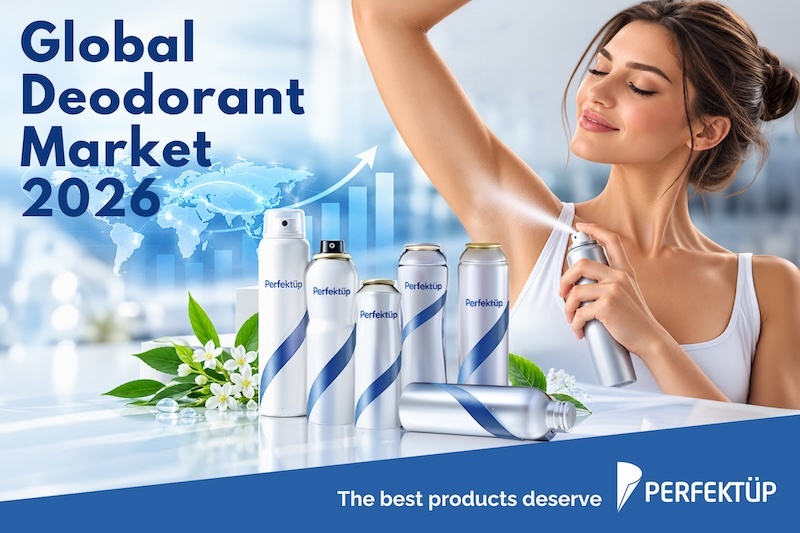
The global deodorant market is entering a new phase of development. What was once considered a relatively straightforward personal care category is evolving into a highly competitive industry driven by changing consumer expectations, formulation innovation, premiumization and growing attention to sustainability. From whole-body deodorants and sophisticated fragrances to natural ingredients and refillable formats, brands are exploring new ways to differentiate products that have traditionally been purchased primarily for their functional benefits.
This transformation is creating new opportunities for manufacturers, but also introducing greater complexity across product development, production and packaging. As deodorants represent a major application for aluminium aerosol cans, understanding where the market is heading has become increasingly relevant for the entire supply chain.
For Perfektüp, which has been manufacturing aluminium aerosol cans since 1975, these developments reinforce the importance of combining market knowledge with technical expertise. Supporting deodorant brands today means understanding not only their packaging specifications, but also the commercial, operational and product-development challenges behind them.
Global Deodorant Market Size and Growth Outlook for 2026
The global deodorant market continues to demonstrate strong growth potential. According to the latest analysis published by Fortune Business Insights in September 2026, the market is projected to reach USD 29.97 billion in 2026, compared with USD 28.41 billion in 2025, the latest complete annual figure available in the report. Looking ahead, the market is expected to expand at a compound annual growth rate of 6%, reaching approximately USD 47.77 billion by 2034.
Recent business performance confirms that deodorants remain a significant growth category for major personal care manufacturers. During the first half of 2026, Unilever reported mid-single-digit underlying sales growth in its deodorant business, with particularly strong momentum in the United States and Brazil. While these results refer to one company rather than the entire market, they illustrate the continuing commercial relevance of the category and the opportunities created by product innovation and portfolio development.
Market growth is increasingly influenced by factors that extend beyond the expansion of personal hygiene consumption. Consumers are looking for products offering more specific benefits, brands are developing additional usage occasions, and fragrance and skincare trends are becoming more closely connected to deodorant purchasing decisions.
Within this expanding market, spray deodorants continue to play a central role. Fortune Business Insights projects that spray products will account for approximately 50.85% of the global deodorant market in 2026, confirming the importance of a format that combines convenient application, rapid drying and broad consumer familiarity.
For aluminium aerosol can manufacturers such as Perfektüp, the relevance of spray formats creates a continuing need for reliable industrial production, but also for greater flexibility in dimensions, finishes and product-specific technical requirements as brands diversify their portfolios.
Changing Consumer Expectations: From Daily Protection to Specialised Personal Care
One of the most important developments in the deodorant industry is the growing diversity of consumer expectations. Odour control and perspiration protection remain fundamental, but they are no longer the only factors influencing purchasing decisions. Consumers increasingly look for products that combine effective performance with skin comfort, pleasant sensory characteristics and benefits suited to individual routines.
The expansion of whole-body deodorants illustrates this transformation. Originally developed primarily for underarm use, deodorant products are now being formulated for additional areas of the body, responding to consumer interest in more comprehensive odour-management solutions. Major manufacturers are investing in specialised formulations, often combining deodorant performance with skincare ingredients and technologies designed to address different skin conditions.
In 2026, Unilever identified whole-body deodorants as an important contributor to its category growth, supported by innovation across brands including Dove, Rexona and Axe. The development of this segment demonstrates how new applications can generate opportunities within an already established product category.
Performance expectations are evolving as well. Long-lasting protection, faster drying, improved fragrance retention and formulations suitable for sensitive skin are becoming important points of differentiation. As a result, deodorant development increasingly requires collaboration between formulation specialists, product designers, packaging manufacturers and filling operations.
For aerosol products, these innovations can introduce additional technical considerations. Differences in fragrance composition, active ingredients, solvent systems and propellants may affect packaging compatibility, making early evaluation of internal coatings, container specifications and dispensing components particularly important.
This is an area where Perfektüp’s technical experience becomes especially relevant. Its expertise in monoblock aluminium aerosol cans includes the evaluation of different internal coating options according to formulation characteristics and intended filling conditions. Working with brands and filling partners from the development stage helps identify potential compatibility requirements before they become production challenges. For deodorant manufacturers introducing new fragrances or specialised formulations, involving the packaging supplier early can therefore support more informed technical decisions and smoother product development.
Premiumization and Fragrance Innovation Are Creating New Value
Deodorants are becoming increasingly connected to the broader beauty and fragrance industries, with premiumization emerging as one of the most relevant opportunities for brands seeking to move beyond traditional price-based competition.
Rather than positioning deodorants exclusively around effectiveness and convenience, manufacturers are introducing more sophisticated fragrance profiles, distinctive product identities and formulations that combine personal care benefits with a more elevated sensory experience. Fine-fragrance-inspired collections, limited editions and collaborations are helping transform an everyday necessity into a product associated with personal expression.
This direction is also highlighted in Mintel’s The Future of Deodorants 2026, which identifies advanced fragrance concepts, specialised formulations and innovative product formats among the developments expected to influence the category over the coming years.
At the same time, the growing interest in natural and ingredient-conscious formulations is encouraging brands to expand their offerings. Products marketed around plant-derived ingredients, aluminium-salt-free formulations and skin sensitivity are gaining attention, although their positioning and performance requirements can differ substantially from those of conventional antiperspirants.
For deodorant brands, these developments create an increasingly diverse competitive environment. Premiumization is not simply a matter of introducing a more expensive product: it requires a coherent combination of formulation performance, fragrance identity, packaging design and consumer experience.
As deodorant brands move towards more premium positioning, packaging differentiation also becomes an industrial challenge. Sophisticated finishes, distinctive shapes and precise colour reproduction must not only enhance shelf appeal but remain consistent across large production volumes and compatible with automated filling processes. A visually successful design must therefore be evaluated alongside manufacturability, dimensional requirements, logistics and production efficiency.
Perfektüp addresses these requirements by combining advanced decoration capabilities with technical development and manufacturing expertise. High-definition printing in up to nine colours, gloss, matte and glitter effects, embossing and customised silhouettes allow brands to create distinctive aluminium aerosol cans, while the evaluation of technical specifications and production feasibility helps translate creative concepts into scalable packaging solutions. This is particularly relevant for international deodorant brands, where visual consistency and reliable reproduction across large quantities are essential to maintaining brand identity.
Sustainability, Refillable Deodorants and the Evolution of Packaging Formats
Sustainability continues to influence how deodorant brands develop products and evaluate their packaging strategies. Consumers are paying greater attention to material use, recyclability and reusable packaging concepts, while manufacturers are exploring ways to reduce environmental impact without compromising product performance or convenience.
Refillable deodorants represent one of the most visible developments in this area. In 2026, Dove introduced a refillable antiperspirant range in the United Kingdom, combining reusable cases with replaceable product refills. According to figures cited by Unilever at the launch, refillable deodorants had grown by 45% over the previous year and represented approximately 4% of the UK deodorant market. These figures highlight a rapidly developing segment, although refill systems still account for a relatively limited share of total category sales.
The success of refillable concepts also demonstrates that sustainability-focused innovation must remain convenient and attractive to consumers. Packaging design, ease of use, product performance and pricing all influence whether a new format can move beyond early adopters and achieve wider market acceptance.
For aerosol deodorants, however, the sustainability challenge follows a different technical path. Pressurised products require containers that maintain mechanical integrity, resist internal pressure and remain compatible with formulations throughout their intended shelf life. Refill concepts developed for sticks and creams cannot therefore be transferred directly to conventional aerosol systems.
Within aluminium aerosol packaging, opportunities for improvement include lightweighting, the incorporation of recycled material, resource-efficient manufacturing and design choices that support collection and recycling.
For packaging manufacturers, translating sustainability objectives into industrial solutions requires more than selecting a recyclable material. Changes in material composition, container weight or geometry must be evaluated against mechanical performance, pressure resistance, dimensional consistency and the requirements of the complete aerosol system. Environmental improvements need to remain compatible with the safety and reliability expected from pressurised packaging.
Perfektüp approaches these challenges through its experience in aluminium manufacturing, material optimisation and the responsible integration of post-consumer and post-industrial recycled aluminium where technically appropriate. Its investment in the Kırklareli production facility also reflects an approach to manufacturing efficiency that incorporates environmental considerations, including resource recovery and energy management. For deodorant brands, this combination of material knowledge and industrial expertise is valuable when evaluating packaging options against sustainability targets without overlooking technical performance.
The central challenge for the industry is not to identify a single sustainable packaging format for every deodorant, but to develop solutions that balance environmental objectives with technical requirements, consumer expectations and industrial feasibility.
Regional Deodorant Market Developments: Where Are the Opportunities?
The deodorant market is expanding globally, but growth opportunities and purchasing preferences vary significantly between regions. Understanding these differences is increasingly important for brands developing international product portfolios.
Europe remains the largest regional deodorant market, accounting for approximately 34.27% of global revenue according to Fortune Business Insights’ most recent complete annual data, referring to 2025. As a relatively mature market, Europe offers significant opportunities through premiumization, fragrance innovation, sustainability-focused products and specialised formulations rather than relying exclusively on increases in consumption.
North America continues to demonstrate strong innovation activity, particularly in whole-body deodorants, premium fragrances and performance-oriented products. The United States has been an important source of growth for major international manufacturers in 2026, with Unilever reporting high-single-digit deodorant sales growth during the first half of the year, supported by market share gains.
Asia Pacific offers a different growth environment, influenced by urbanisation, increasing personal care awareness, rising purchasing power in several markets and the expansion of modern retail channels. Consumer preferences vary considerably between countries, however, making localised fragrance profiles, product positioning and format selection important elements of market development.
Latin America also remains strategically relevant, particularly for established spray deodorant brands. Brazil provides a recent example of the region’s potential: Unilever reported high-single-digit deodorant growth in the country during the second quarter of 2026, supported by higher sales volumes and adjustments to its product format mix.
Across the Middle East and Africa, opportunities are influenced by demographic developments, climate conditions, retail accessibility and the expansion of personal care product ranges, although purchasing power and distribution environments differ substantially between markets.
For international deodorant manufacturers, these regional variations create a practical challenge: maintaining consistent product and packaging quality while adapting formats, dimensions, decoration and price positioning to different commercial environments.
This is where international manufacturing experience becomes a competitive advantage. A deodorant brand operating across multiple regions needs packaging solutions that accommodate different product portfolios and commercial requirements without introducing unnecessary variations in quality or production performance. With manufacturing operations in Türkiye, Bulgaria and Italy and customers in more than 50 countries, Perfektüp has developed experience serving international markets and managing diverse customer specifications. Its industrial capabilities allow the company to support brands seeking both product differentiation and consistency across their packaging portfolios.
How Deodorant Market Trends Are Changing Aluminium Aerosol Packaging Requirements
As deodorant brands introduce new formulations, premium product ranges and increasingly diversified portfolios, packaging requirements are becoming more complex.
The first consideration remains product compatibility. Formulation characteristics, including active ingredients, solvents, fragrance compounds and propellants, must be evaluated in relation to the aerosol container and its internal coating. The correct packaging configuration depends not only on the product itself, but also on storage conditions, filling parameters and expected shelf life.
At the same time, premiumization is increasing the importance of packaging design. Distinctive shoulder profiles, customised shapes, embossed details and sophisticated decoration can help brands establish a recognisable visual identity, particularly in competitive retail environments where packaging often represents the first interaction between the consumer and the product.
These requirements must be balanced with industrial efficiency. A successful aerosol packaging solution must maintain dimensional consistency, mechanical reliability and decoration quality across large production volumes, while remaining suitable for the customer’s filling operations.
For major deodorant manufacturers, packaging reliability is closely connected to production continuity. Small variations in dimensions, coating application or container geometry can become significant when millions of units are processed on automated filling lines. A packaging solution must therefore demonstrate consistent behaviour not only during initial qualification, but throughout repeated production batches, particularly when brands operate across several product ranges or markets.
Perfektüp addresses these requirements through its expertise in monoblock aluminium aerosol cans, supported by internal R&D capabilities, established quality management systems and decades of manufacturing experience. The company’s product range includes different diameters, shoulder profiles, customised shapes, internal coating options and decoration technologies, allowing packaging specifications to be evaluated according to the requirements of each project.
With an annual aerosol can production capacity of approximately 240 million units, strengthened by the investment in its Kırklareli facility, Perfektüp combines industrial scale with technical development capabilities. Its quality management approach, supported by international standards and production controls, contributes to the consistency required for large-volume packaging projects.
For deodorant brands, the value of this expertise goes beyond the characteristics of an individual container. It lies in the ability to work with a manufacturing partner that understands how packaging design, formulation compatibility, filling-line performance and production volumes interact, helping customers identify potential constraints early and develop reliable solutions for industrial application.
The Future of the Deodorant Market: Innovation Requires the Right Industrial Partners
Looking towards 2030 and beyond, the deodorant industry is expected to become more diversified rather than converge around a single dominant product concept. Conventional antiperspirants and aerosol deodorants will continue to coexist with specialised formulations, premium fragrance-led products, refillable systems and emerging application formats.
The industry’s future will increasingly depend on its ability to respond to different consumer expectations while maintaining effective product performance and commercially viable manufacturing processes. Innovation will remain important, but so will the capacity to deliver new concepts consistently and efficiently across international markets.
For aerosol deodorants, this means that packaging development cannot be separated from formulation choices, sustainability objectives, consumer experience and industrial production requirements.
This is where the relationship between deodorant brands and packaging manufacturers becomes particularly relevant. The value of an experienced industrial partner extends beyond the supply of containers: it includes understanding market developments, anticipating technical challenges and helping customers translate product ideas into scalable packaging solutions.
With a manufacturing history dating back to 1955 and decades of specialised experience in aluminium aerosol cans, Perfektüp combines established industrial know-how with technical development, manufacturing capacity and an understanding of international market requirements. Its role is not limited to producing packaging according to a predefined specification, but extends to supporting customers as they evaluate the technical and industrial implications of their product decisions.
As the deodorant market continues to evolve, the packaging manufacturers best positioned to support its development will be those capable of combining market awareness, engineering expertise and consistent industrial execution. For Perfektüp, these elements form the foundation of long-term partnerships with personal care brands seeking packaging solutions that respond to today’s requirements while remaining adaptable to future opportunities.